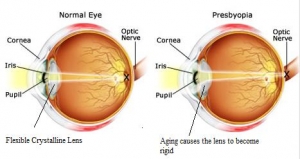
There is a three stage classification system for presbyopia. This is based on the normal phases of crystalline lens changes that occur with aging.
The lens ages similarly to the skin. As disulfide bonds accumulate inside the lens through all three stages, the lens loses flexibility and its density increases.
Stage 1- average age of 43 years. The lens is clear and colorless but lens loses its ability to change power as a result most patients have difficulty reading up close. Two surgical presbyopia correcting options are available during this stage at the best laser eye hospital in Mumbai which is Ojas eye care hospital at Bandra and the other Ojas Eye Care Hospital at Kandivali.
The two surgical treatment options of Stage I Presbyopia are
- Monovision LASIK
- Refractive Lens exchange called Presbyopia refractive Lens exchange ( PRELEX)
Stage 2 occurs in patients in their 50- 60’s, when lens becomes yellow and clouded. Patients require more light to read and have difficulty in night vision.
Treatment is removal of the lens called Refractive Lens Exchange. It is similar to cataract surgery and in Mumbai is done at Ojas Eye Hospital, Bandra and Ojas Eye Hospital, Kandivali.
Monovision LASIK in StageII Presbyopia will not last long and hence not recommended.
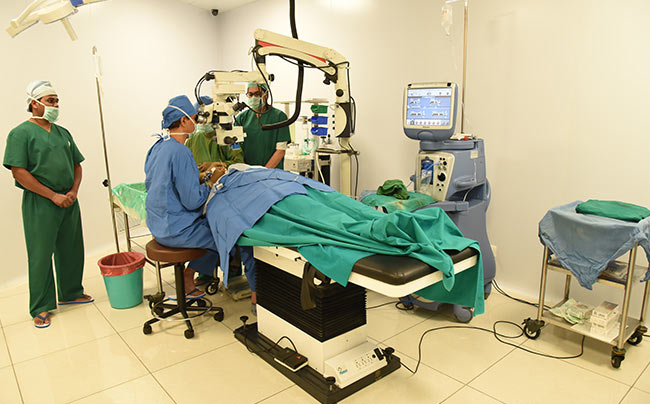
Stage 3 Presbyopia usually occurs at an average age of 73 years and patients have a cataract. The only treatment at this stage is surgery and cataract surgery in Mumbai is done with the latest technology of Microincision bladeless phacoemulsification ( MICS )and foldable premium intraocular lens implantation at Ojas Eye Hospital at Bandra and Ojas Eye Hospital at Kandivali. It is done by one of the best eye surgeon in Mumbai, Dr. Niteen Dedhia – leading eye specialist and Cataract surgeon of India.
Tags: best eye surgeon in Mumbai, best laser eye hospital in Mumbai, cataract surgery in Mumbai, Eye Care Hospital at Kandivali, Eye Hospital In Bandra, Prelex surgery In Mumbai, Presbyopia correction

Bladefree Lasik is a treatment for vision correction approved by “NASA Astronauts”. It is also a US FDA approved procedure for those who seek to be free from spectacles to get rid of their glasses.
This procedure is done at Ojas Eye Hospital in Bandra, Mumbai
What is Intralase Bladeless femtosecond Lasik?
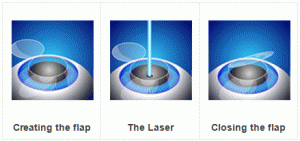
Femto Lasik is a 100% Bladefree approved using ultra high precision femto second Laser for safety & accuracy of the whole treatment. By eliminating the handheld microkeratome blade method used in traditional Lasik for corneal flap creation, there’s higher level of safety & accuracy in laser procedure.
With intralase using a computer controlled laser the surgeon deliver rapid pulses of laser light to a pre-programmed depth and position within the corneal tissue.
This technique is available as of “the best laser eye hospital in Mumbai”.
Ojas Eye Hospital is also able to treat patients with this method who have this type of cornea which otherwise would have been turned down for the traditional Lasik Procedure.
It is performed by Dr. Niteen C Dedhia who is a pioneer of Bladefree Lasik in Bandra, Mumbai.
And is a past “President of Bombay Ophthalmologists Association”. He is also ranked amongst the best eye surgeon in Mumbai.
Is Custom Intralase Bladefree Lasik Safe and trusted.
This technology gives the doctor an extremely high degree of surgical control for exceptional outcomes. Millions of procedure have had been performed safely all over the world & in India Ojas Eye Hospital the best eye specialist in bandra, mumbai to carry out this treatment.
The corna after the femto treatment is reshaped with the excimer laser & vision correction done for Myopia with or without Astigmatism for correction of Hyperopia more deails can be availed from Ojas–Eye Hospital in Bandra, Mumbai & Ojas Eye Hospital in Kandivali, mumbai which have the latest facility to treat these refractive error.
Tags: Bladefree Lasik Surgery In Mumbai, Eye Hospital In Bandra, Eye Hospital In Kandivali, Eye Hospital In Mumbai, laser eye hospital in Mumbai, Lasik eye surgery in Mumbai, Lasik treatment in bandra, Lasik treatment in Mumbai

In recent times Removal of cataract is focused more on making one free from glasses by correcting the eye glass power for distance, near and intermediate vision alongside with stitchless patchless and injection free cataract removal. At Ojas Eye Hospital one of the best eye hospital in Mumbai, this surgery is performed with the most advanced IOL’s (intra-ocular lens) for correction of presbyopia (vision for near and far), and astigmatism (correction of cylindrical numbers) and correction of spherical and chromatic aberration.
Toric lens implantation is also carried out to correct astigmatism upto ± 0.5 D to 6 D thereby improving the distortion from cylindrical number.
The latest technology for microincision phacoemulsification is Torsional phaco which is available at Ojas Eye Hospital in Kandivali & Ojas Eye Hospital in Bandra. Cataract surgery in Mumbai has come up to international standards with the availability of advanced technology laser equipment and specialised intra ocular lenses especially toriclenses. Advancement in IOL technology improves Visual functionality by creating customization in IOLs . In a relatively short time cataract surgery in Mumbai has been transformed from a procedure with significant morbidities and high risk of vision loss to one of the safest and functional procedures in modern medicine.
Categories:
Tags: best eye hospital in Mumbai, cataract surgery in Mumbai, Eye Hospital In Kandivali, Ojas Eye Hospital in Bandra
We Also Treat Lasik, Retina and Keratoconus

Cataract Treatment In Mumbai
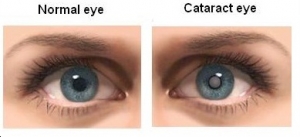
The opacification of the normal transparent lens is called cataract. The Latin word ‘cataracta’ means ‘waterfall’. Imagine trying to peer through a sheet of falling water or through a frosted or fogged-up window. Development of Cataract varies from person to person but as a general rule, most cataracts develop slowly over a period of time. A cataract can take months or even years to reach a point where it adversely affects vision.
Causes of cataract
Age-related cataract
The cataract occurs as a result of the natural aging process of lens fibres which become opaque over a period of time.
Traumatic cataract
- Due to a direct penetrating injury.
- Concussion- Electric shock and lightning.
- Ionizing radiation done as treatment for ocular tumors.
- Surgical trauma
Metabolic cataract: Defect in body metabolism
- Diabetes
- Galactosaemia -inborn error of metabolism
- Calcium disorders
Steroid-induced cataract
This occurs as a result of excess intake of oral steroid or putting steroid drops in the eye.
Secondary cataract
Here, cataract develops as a result of some other primary ocular disease such as chronic eye inflammation or glaucoma.
History of Cataract treatment
The earliest surgery treatment was started in India, by Maharshi Sushruta. It was known as ‘couching’, where the cataractous lens was dislocated backward into the bottom of the eye and out of visual axis.
This procedure was performed for more than two thousand years until the mid-eighteenth century. Great progress in cataract surgery has been made in recent years with the introduction of micro-surgical instruments, microscope and modern surgical techniques like phacoemulsification, which has made couching obsolete.
In the early stages of cataract development, all that is needed to correct your vision with glasses is a change in prescription. As the cataract develops and begins to affect your lifestyle, it needs to be removed. Cataract surgery, the most commonly performed operation, is safe and effective in 95% patients with enhancement in vision.
Methods of evaluation of cataracts:
Visual acuity: Checking vision of both eyes unaided and aided with glasses and pin-hole vision to know the improvement as well as to get the general idea about the macular function of the eyes. This will help in prognostic evaluation of visual recovery after cataract surgery.
Intra ocular pressure: If intra-ocular pressure increases as a secondary to cataract, surgery is needed to prevent further complications.
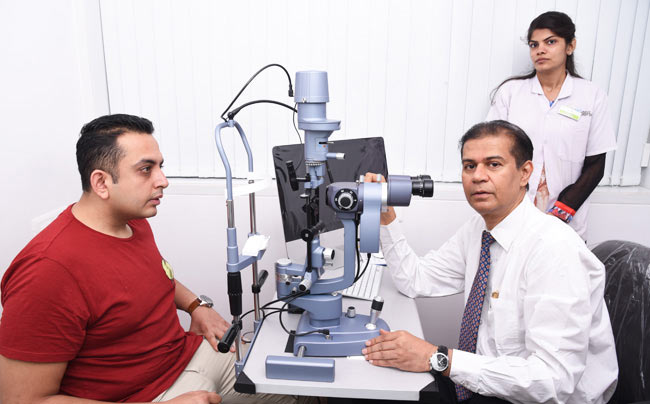
Slit-lamp examination: To know the type of cataract along with its opacity, morphology and etiology or any associated ocular pathology.
Direct and indirect ophthalmoscopy: for complete retinal evaluation. Dense cataract will prevent retinal evaluation and such cases need B-scan for retinal evaluation.
A-scan biometry: To calculate the AL and IOL power for implantation in cases of mature cataract the posterior segment of the eye is evaluated.
Optical biometry: this is an advanced non contact method to measure IOL power. It is patient friendly and highly precise
For More detail https://www.cataractindia.in/

LASIK or ‘Laser-Assisted In Situ Keratomileusis’ is one of the most trusted laser eye surgeries for the treatment lasikasaof Myopia (near-sightedness), Hyperopia (far-sightedness), and Astigmatism (blurred vision). This laser vision correction technique is performed on the cornea so that light entering the eye can be focused on the retina for clearer vision. LASIK will completely eliminate your dependence on spectacles or contact lenses in a short 15 minute surgery.
What Is Custom Lasik?
Custom LASIK is a procedure that involves the use of a wavefront analyzer which helps the surgeon to customize the LASIK procedure to every individual eye. Customized procedure enables a person to see clearer and shaper than before and thus improves the quality of vision.
Custom LASIK uses an equipment called the wavefront analyzer (aberrometer) to accurately measure the way light travels through the eye.The resulting map of the eye is then programmed into the laser, which then treats the eye, based on the personalized 3Dmap.Custom LASIK helps to treat “higher order” aberrations,which are tiny imperfections in the optical system of the eye. They have a significant impact on the quality of vision especially at night . In fact, higher order aberrations are not treatable with contact lenses, glasses or conventional LASIK.
Is Custom Lasik Procedure Same As Conventional Lasik ?
The procedure for both custom LASIK and Conventional is the same but the pre assessment tests differ greatly. The wavefront analyer used with custom LASIK brings a whole new level of knowledge and accuracy for the surgeon to perform this advanced procedure. This treatment has a significant impact on quality of vision and eliminates the problem of glare and halos at night. Topography, Aberrometry and Pachymetry are pre-operative tests required.
Opti Lasik
Opti Lasik combines today’s advanced surgical technologies into a procedure optimized for individual vision needs with minimum tissue ablation.
- Many measurements are taken to determine the unique shape of the eye
- The Laser reshapes the cornea using energy pulses based on the individual unique correction profile
- This allows incoming light to be precisely focused on the retina.
Advantages
- Smooth treatments
- High level of comfort
- Excellent accuracy
- Proven safety
EPI-LASIK
Epi-LASIK is a newer laser eye surgery procedure that was developed to solve some of the potential problems with LASIK and LASEK. It’s somewhat of a cross between the two, but differs in a few key areas. With advent of Intralase Bladfree technique Epi-lasik is now obsolete.
Presbyopic Lasik
Presbyopia-test1PreLEX treatment (Presbyopic Refractive Lens Exchange) is a lens replacement procedure wherein the natural lens is replaced with a multi-focal intra-ocular lens implant. This is done to improve vision for those generally above the age of 40, as it is after this age that one’s eye sight begins to naturally become weak—causing blurred near vision while reading or working at the computer, or blurred far vision when looking at something from a distance.
For more Detail https://www.ojaseyehospital.com/refractive-surgery-or-lasik-treatment.html